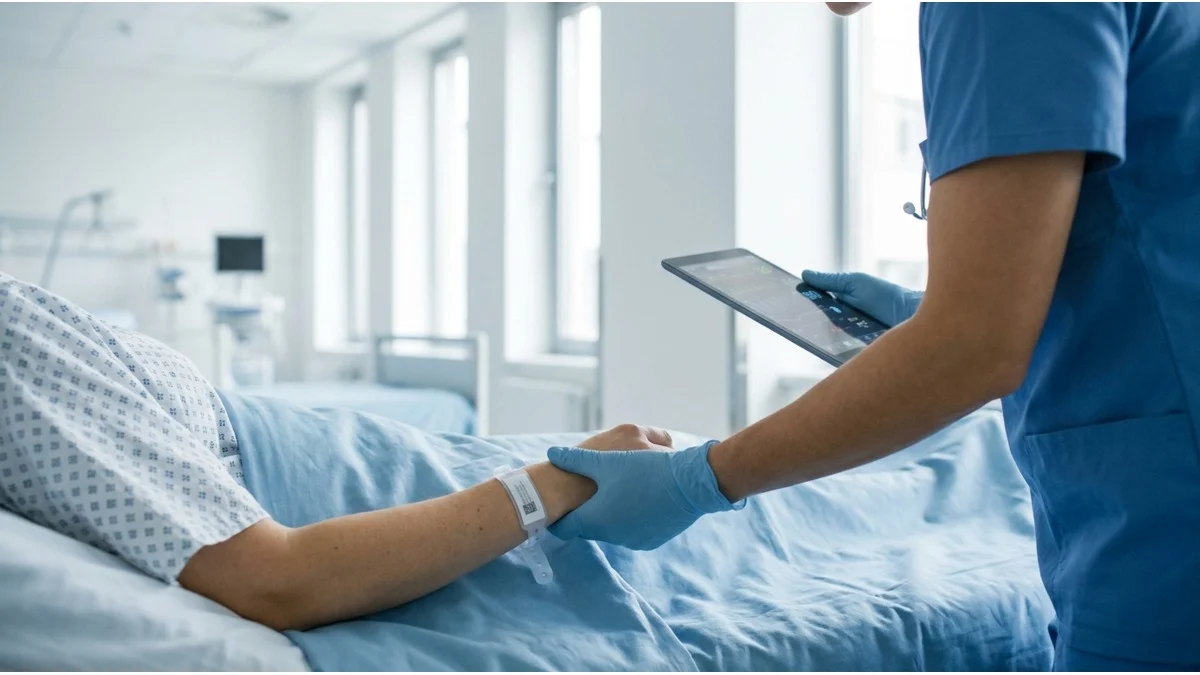
Patient safety during their hospital stay — or during hospitalization — goes far beyond sophisticated equipment and complex protocols. Simple measures, such as checking identity at every stage of care, are among the most effective barriers to prevent care errors. A study that analyzed patient experience regarding safety in the hospital environment reinforces this point and helps understand why the topic is a priority for managers and healthcare teams.
The article, published in SciELO, aimed to analyze the factors that can impact patients’ experience regarding safety measures in the hospital. More than a technical snapshot, the research shows that the patient’s perception of their own safety is directly linked to how professionals communicate and conduct basic procedures. When identification is done clearly and repeatedly, the patient feels welcomed and more willing to collaborate.
What makes identity checking a pillar of safety?
According to the MSD Manuals, a typical day in a hospital starts early: between 5 a.m. and 8 a.m., a professional collects blood so that the results are available during medical rounds. This routine, carried out in a highly complex environment with many patients, requires rigorous standards. It is precisely during peak hours — shift changes, transport for exams, preparation for surgeries — that the risk of errors increases.
In this context, simple acts such as asking for the full name, checking the date of birth, and verifying the wristband before administering a medication are fundamental. They connect the right patient to the right treatment. Studies on patient safety highlight that identification must be done using at least two identifiers, never by the room or bed number. The bed number changes, but the name and date of birth remain.
When the hospital routine leaves room for error
The NHS describes an inpatient as someone who needs to spend the night in the hospital to undergo an operation or an exam. During this period, they receive care from different professionals: doctors, nurses, nutritionists, pharmacists, and technicians. Each of these professionals may perform a specific intervention. Without systematic checking, it is impossible to ensure that the intervention is intended for the correct person.
Furthermore, the patient’s clinical condition can make communication more difficult. Sedated, confused, or language-barrier patients depend even more on objective identification mechanisms. The wristband, the electronic medical record, and verbal confirmation combined form a safety system that protects even those who cannot answer for themselves.
Patient experience as an ally of safety
The research made available by SciELO analyzed the experience of hospitalized patients and the factors that influence their perception of safety. The study is especially relevant because it places the patient at the center of the discussion. Often, the person receiving care notices subtle failures — such as the lack of a team introduction or a hasty question — that can go unnoticed in technical audits.
When the professional introduces themselves, explains the procedure, and asks for identity confirmation, they create a bond. The patient stops being a spectator and becomes an active participant in their own safety. This change in attitude is one of the most cited factors in qualitative studies on the topic and is aligned with patient safety initiatives disseminated worldwide.
Visits and companions: support that needs guidance
Health New Zealand | Te Whatu Ora emphasizes that visits are welcome and are part of the patient’s recovery and well-being. However, the same document indicates that the presence of visitors must follow practical rules, such as bringing small amounts of food and respecting routines. The guidance also extends to safety: family members need to understand why the team repeats questions and avoids using the patient’s name as the only identifier.
East Liverpool City Hospital, in turn, reminds that doctors, nurses, and caregivers meet with the family to discuss the patient’s condition, care instructions, and activity restrictions during recovery. These conversations are important opportunities to align expectations and reinforce the importance of correct identification. A well-informed family member helps keep the environment safer and reduces anxiety in critical moments.
Technology in favor of care, without replacing the human factor
The healthcare sector has invested in innovations to make hospitalization safer. The University of Pisa, the Italian Institute of Technology, and the Maugeri group, for example, are bringing robotics to hospital wards, according to institutional news. These robots can assist with operational tasks, but they do not eliminate the need to verify the patient’s identity. On the contrary: any technological tool must be integrated into the identification flow to add value.
A digital medical record, a wristband with a barcode, or an electronic prescription system are useful only if professionals confirm the data at the bedside. Technology reduces the risk of transcription errors, but the final check still depends on human attention. Therefore, patient safety programs must combine investment in systems with continuous training of teams.
Practical guidance for patients and families
Patients and their companions can make a difference during their hospital stay. Some simple attitudes help protect against adverse events:
- Check that the identification wristband is present, legible, and with correct data.
- When receiving a medication, state your full name and date of birth, without assuming the professional already knows.
- Always ask which procedure will be performed and why.
- Do not accept interventions without team confirmation, even in emergencies.
- Write down allergies, previous illnesses, and current medications to share with all shifts.
- Notify immediately if the wristband comes off, gets wet, or becomes illegible.
- Encourage the patient to speak for themselves, whenever they have the clinical conditions to do so.
These actions do not replace the institution’s responsibility, but they create a protection network in which the family plays an active and informed role.
Frequently asked questions about safety and identification in the hospital
Why is identity checking so important in the hospital?
It is the first barrier against medication, exam, and procedure errors. It helps ensure that each care action is applied to the right patient, in an environment with many variables and information exchanges.
What to do if the patient loses or damages the wristband?
Notify the nursing team immediately. Until a new wristband is placed, the patient should undergo any intervention only after rigorous verbal confirmation.
Is asking the name every time a way of distrusting the team?
No. It is a technical safety standard adopted internationally. Repetition prevents everyday familiarity from leading to dangerous assumptions. When done with communication skill, the question does not cause embarrassment.
Is the identification wristband enough to ensure safety?
The wristband is an important element, but it is not enough. It must be combined with verbal confirmation, consultation of the medical record, and data checking before each procedure. Safety is a system, not a label.
Conclusion
Patient safety during their hospital stay depends on a set of practices that seem small but have a great impact. The study on patient experience, as well as the institutional materials from the NHS, the MSD Manuals, and Health New Zealand, show that standardization of identification is one of the simplest and most effective measures to reduce harm. More than a bureaucratic requirement, identity checking is a gesture of care. When everyone — team, patient, and family — understands its value, hospitalization becomes a safer, more human, and more trustworthy environment.
This article is for informational purposes only and is not a substitute for professional medical advice, diagnosis or treatment. Always consult a qualified healthcare provider before changing your diet, starting a supplement or altering any treatment.
Conflict of interest: The author and medical reviewer of this article report no financial relationship with any brand mentioned. Product recommendations are made independently of any commercial arrangement. Leia nossa política editorial.